


University of Tor Vergata – Department of Biology Dr. Carla Montesano – Coordination and teaching for immunology trainincoordination and teaching for immunology training in infectious diseases and innovative technologies applied to the diagnosis and monitoring of infections. Dr. Daniele Mezzana – Key areas of interest: African societies, Relationships between science and society, evaluation of development projects, corporate social responsibility, civil society organizations, rule of law, communication issues, rural development. 1. How do you understand “Public engagement” in biosciences research? Within the framework of “Responsible Research & Innovation” (RRI), public engagement is a crucial key. Such a key is about promoting the engagement of all societal actors in the research and innovation process. This aspect is very important in biosciences: from the economic point of view, this sector is highly research-based (above all after the “molecular revolution” occurred several decades ago), and is characterized by the cooperation between academia, public and private research centers, industry, etc… But the economic, and also political, social, and ethical issues, Biosciences cope with the involvement of many kind of actors besides researchers and industry, such as policy makers, civil society organizations, schools, medias, and others. 2. What are the current standards and actions to achieve better “Public engagement” in your country and in your University? We may recall that the Italian Agency for the Evaluation of Universities and Research Institutions defined as “Public Engagement” in a more specific sense, is not for profit activities carried out by universities having an educational and cultural aim for …
Gender in Biosciences, seen by Oxford University
Dr. Laurel Edmunds – is a Senior Research Fellow working in collaboration with the NIHR Oxford BRC and relevant researchers across the University of Oxford. She is currently leading on a series of systematic reviews evaluating women in academic medicine and research efficacy in the NIHR Oxford BRC. 1. How do you understand Gender in biosciences research? Gender is of growing importance in bioscience research for two main reasons. First, women should not be disadvantaged or treated differently in the workplace just because they are women. Second, as more and more women are going into scientific careers, they are bringing new perspectives and alternative approaches. We cannot afford to lose these resources from the biosciences. 2. What are the current standards and actions to achieve better Gender in your University and in your country? Since 2008 we have had the Athena SWAN Charter for improving gender equality in sciences in the UK. Higher education institutions sign up to the Charter and then apply for an award (either Bronze, Silver, Gold) and complete applications with supporting evidence, and submit these to the Athena SWAN organisation. Bronze requires an assessment of gender equality, a 4-year action plan and an organisational structure that can deliver the plan; Silver is awarded when a department has delivered and shown an impact from these actions; Gold these are maintained and the department supports others. Few science departments hold a gold award as they are difficult to get and keep. There is now a similar Charter …
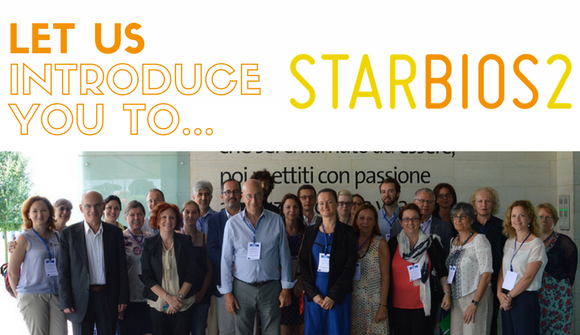
Let us introduce you to STARBIOS2…
Vittorio Colizzi, coordinator of STARBIOS2 project, is Full professor of General Pathology and Immunology, and Director of UNESCO Chair in Biotechnology and Bioethics at University of Rome “Tor Vergata”. He will talk about the aim of the project and the concept of Responsible Research and Innovation (RRI). 1. How would you describe the concept of Responsible Research and Innovation? In short, RRI is an inclusive approach to research and innovation (R&I). It aims to better align both the process and outcomes of R&I with the values, needs and expectations of European society, and to ensure that societal actors work together during the whole research and innovation process. 2. Why is RRI important for the advancement of the research? Research and innovation have never been carried out in isolation from the social, political and economic context. But the RRI helps us to highlight an important fact: one of the main risk, for European research is its inadequate connection with society. The loose connection between research and society could make European research unable to address the key development problems, unable to exploit its potential for innovation and competitiveness in the global market, and socially isolated or contested (see the case of the attitude of many citizens towards the vaccinations). For these reasons, RRI is important, because it focuses on the subject of a stronger R&I, and even more relevant with respect to society; a society of which R&I itself is an integral part. 3. Could you describe the 5 key issues …