Want to receive STARBIOS2 news? First newsletter issued!

Want to receive news from STARBIOS2?

Editorial TeamRRI

Want to learn about ways to improve citizens’ understanding of science, or how to create a supportive and inclusive university culture? Today, we issued our first newsletter, where we share news on recent publications and the different activities by partners who actively work to change structures in their own institutions. Aiming to achieve responsible biosciences.

You can view the newsletter here and subscribe to hear more from us in the future!

Improving citizens' understanding of science

Improving citizens’ understanding of science

Editorial TeamRRI

With an appropriate understanding of the scientific process, citizens can cultivate well-founded views on scientific issues. This is fundamental to enable co-creation, or “citizen-science”. In her recently defended thesis, Julia Birkholz makes the case for using “Reflective Reviewing Cafés” (RCs) to enhance citizens’ understanding of science and the scientific process.

“Allowing students to reflect on the scientific process is a way of encouraging lifelong, attentive learning,” says Julia Birkholz who successfully defended the second doctoral thesis on 24 May.

This STARBIOS2 thesis, supervised by Doris Elster, is titled “Study on the efficacy of Group Reflections on the Understanding of Nature of Science in the Outreach Laboratory Backstage Sciences”.

Draft guidelines under review - STARBIOS2

Draft guidelines under review

Editorial TeamRRI

Right now, external reviewers are looking at the first draft RRI guideline document from the STARBIOS2 project. The text is designed to be a tool for guiding readers in self-reflection over the reasons and ways that different organizations can move towards changing structures to promote responsible research and innovation. We have asked our reviewers to give input and let us know if the text is comprehensible, comprehensive, useable and relevant.

In essence, we are asking if people who are new to RRI and structural change can understand the guideline. We also want to know if we have included everything that is needed to equip the readers to promote RRI practice. Also, we need to know if it is useful, and whether it addresses the problems and challenges that bioscience research organizations face in different countries.

We expect input from the review process in the beginning of June. Which puts us right on track to deliver our final reports in April 2020.

By Josepine Fernow

NEW PUBLICATION: Creating a supportive and inclusive university culture

Creating a supportive and inclusive university culture

Editorial TeamRRI

How can funding agencies help create a more supportive and inclusive university culture? A recent study from Oxford University shows that there are differences between how women and men perceive the university culture. Moreover, these differences are more noticeable in the social sciences than in medicine. The authors suggest that a gender equality award or certification system linked to funding incentives could be the key to creating a more supportive and inclusive culture for all faculty and staff.

The study shows that while the organisational culture influences research productivity, career advancement and career satisfaction of all faculty and staff, the dominant university culture disadvantages women.

Researchers at Oxford University and the National Initiative on Gender, Culture and Leadership in Medicine: C-Change at Brandeis University surveyed 4997 of faculty and staff members in the medical and social sciences at Oxford University to investigate the organizational culture and look for ways to improve it. The C-Change survey included 12 dimensions of university culture, spanning from career advancement and institutional support, to gender and ethnic equity.

The authors used a combination of quantitative and qualitative methods. They were able to show that the implementation of Athena SWAN gender equality action plans linked to funding incentives contributes to positive culture change towards a more supportive and inclusive culture. Not only for women, but for all faculty and staff.

According to Pavel Ovseiko, lead author and member of the STARBIOS2 consortium funded by the Horizon 2020 programme ‘Science with and for Society’ to advance Responsible Research and Innovation in Europe, the success of UK and Irish funding bodies in introducing funding incentives linked to Athena SWAN could serve as an inspiration to research funders in many other countries.

“By linking major European research funding, such as the upcoming Horizon Europe programme, to measurable outcomes in gender equality and diversity the European Commission could help European research organisations and universities  improve their culture and better align their research with the values, needs, and expectations of European society. Perhaps through an award or certification system similar to Athena SWAN”, says Pavel Ovseiko.

Athena SWAN is widely adopted in the UK, Ireland, Australia, Canada, and the United States. The UK National Institute for Health Research, Science Foundation Ireland, the Irish Research Council, and the Health Research Board have successfully linked their funding to Athena SWAN awards. The European commission has proposed developing scenarios for the introduction of a similar gender equality award/certification system.

The paper, Creating a more supportive and inclusive university culture: a mixed-methods interdisciplinary comparative analysis of medical and social sciences at the University of Oxford, is published in Open Access in the Special Issue of Interdisciplinary Science Reviews on Gender and Science edited by Dr Elizabeth Pollitzer https://doi.org/10.1080/03080188.2019.1603880

This study was supported by Oxford University’s Vice Chancellor’s Diversity Fund, by the Horizon 2020 award STARBIOS2 (grant No. 709517), and by the NIHR Oxford Biomedical Research Centre (grant BRC-1215-20008).

By Josepine Fernow

Breaking the ceiling

Breaking the Ceiling: Women in International Higher Education and STEM

Editorial TeamRRI

From 6-10 May the Erasmus Staff Week takes place at the University of Bremen. This year’s focus is retaining women in the international higher education and STEM fieds. STARBIOS2’s Doris Elster will be there to give a talk on recruiting and retaining female students to STEM education.

Professor Doris Elster will give a talk on developing strategies to recruit and retain women in STEM study programmes.  During her presentation “It´s my choice. Women in Science and Technology Studies”, she will stress how we need more information about the priorities, values and experiences that motivate first-year-students’ academic and educational choices.

Based on a comprehensive questionnaire survey in German and Austrian Universities (with 3000 participants in each country), Doris Elster and her colleagues analysed reasons why female students choose STEM studies, why some of them choose to continue their studies, and why some choose to drop out. Their findings form the basis of recommendations to recruit and retain female students at the Faculty of Biology and Chemistry at the University of Bremen, and for the educational building blocks “Gender in Research”. The educational building blocks are part of this gender toolbox offered on-line to interested researchers and students.

University of Bremen is one of 12 STARBIOS2 partners, working to enhance responsible research and innovation (RRI) in bioscience.

Technology Transfer and RRI: Connecting science with society

Technology transfer and RRI: Connecting science with society

Editorial TeamRRI

Moving discoveries between domains is not easy. No matter how noble your cause, several problems can arise in real-life tech-transfer situations. At a workshop in at the University of Maryland Baltimore (UMB), STARBIOS2 members had the opportunity to share and gain new insights on the connection between successful technology transfer and Responsible Research and Innovation (RRI).

During the workshop, STARBIOS2’s Vittorio Colizzi emphasized the value of fostering a culture of RRI in your institution and connecting science with society. Tech-transfer can be made easier by connecting research to the local community, making results open access, ensuring gender equality in the research process and content, using ethical procedures, and promoting science education.

To do implement RRI in your institution, you need to understand and describe your institution’s context. Every bioscience institution is different, and the first step towards creating an action plan for responsible research and innovation is contextualization. Accepting that context is next, followed by formalising the goals you set out to achieve in this context. Identifying obstacles and mobilizing the action plan is next.

Funders can be hesitant to support research that will not have an impact in their local community. Another obstacle is the lack of validated data that a translational core is able to provide (e.g. testing in small animal models). Public opinion can also hinder technology transfer, but persistence is key when delivering valuable technology to a resistant society. Technology transfer is an essential part of bioscience. Sorting out potential conflicts of interest early in the process is central.

Giving community members a voice is important, so that they can weigh in on what makes an effective and successful research collaboration. There is a need for communication strategies to aid the recruitment of research participants, and for listening to community members’ views on issues related to community-based participatory research.

Universities are currently expanding their mission to improve the region’s economic development by educating and training the workforce, by helping government solve complex problems, by creating new enterprises, and by collecting and disseminating information about the local economic ecosystem. UMB offers a course to post-grad students, educating the students on Baltimore’s innovation ecosystem and providing them with tools to make an impact on it.

Public engagement is easier with stakeholder networks in place, and when including junior researchers in the process. With limited resources, much bureaucratic red tape, and insufficient incentives, it becomes more difficult.

Providing better access to STEM education and introduce students to professionals in the health sciences to disadvantaged communities is important, but difficult. Through neighbourhood visits, researchers get a better idea of what their local community, and others like it, needs. It is vital to not only engage the community when you want to start a clinical trial, but to make efforts to visit neighbours and listen to people expressing their views. This is an essential step in (re)building society’s trust in science. And in preparing the ground for successful technology transfer.

Anna Holm

SPEAKERS AND PANELISTS

Vittorio Colizzi, MD PhD, Professor and Director of the University of Rome – STARBIOS2

Andrea Declich, MSc, social scientists – STARBIOS2

Claire Fraser, PhD, Director of UMB’s Institute of Genome Sciences and President-Elect for AAAS

Jim Kaper, PhD, Chairman of the Department of Microbiology and Immunology and University of Maryland, School of Medicine’s (UMSOM) Vice Dean for Academic Affairs

Phil Robilotto, DO MBA, Associate Vice President of ORD and the head of Technology Transfer (now UM Ventures, Baltimore)

Stephen Davis, MBBS FRCP FACE MACP, Chairman of the Department of Medicine at UMSOM, and Vice President of Clinical and Translational Science at UMB, and Director of the Institute of Clinical and Translational Research (ICTR)

Meriem Gaval-Cruz, PhD, liaison between ICTR and the UMB Office of Technology Transfer

Rana Quraishi, PhD is the Director of New Ventures and teaches UMB’s post-graduate course in Entrepreneurship

Maria S Salvato, PhD, professor at UMB’s Institute of Human Virology

Karen Matthews, DM MPA, UMB’s Director of Strategic Planning and Assessment

Lori Edwards, DrPH RN MPH, Senior Director of the Center for Global Education Initiatives

Kelly Quinn, PhD, Senior Manager in the Office of Community Engagement

Robin Saunders, EdD, Executive Director of the CURE Scholars Program on UMB campus

Jim Hughes, MBA UMB Vice President, Director of UM Ventures and Chief Enterprise and Development Officer for UMB


 

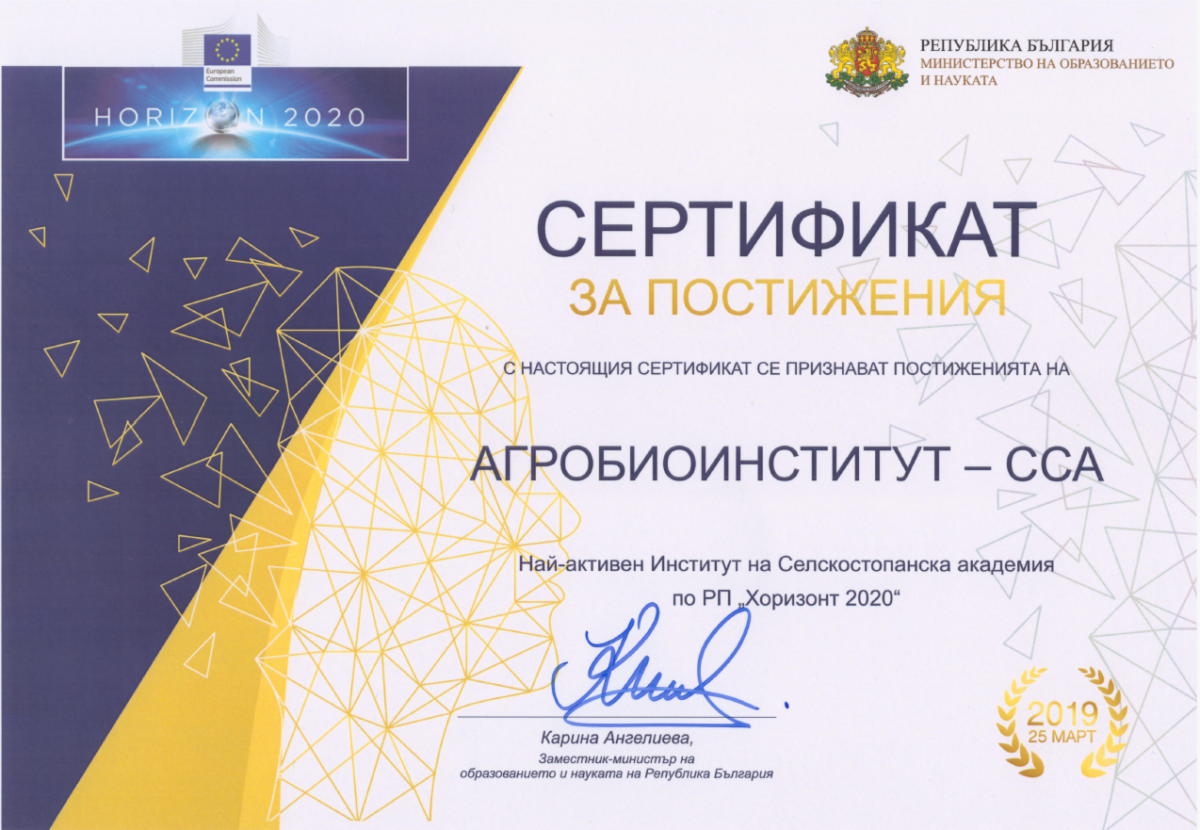
ABI's certificate for winning the award.

Agrobioinstitute awarded by Bulgarian Ministry of Education and Sciences

Editorial TeamRRI

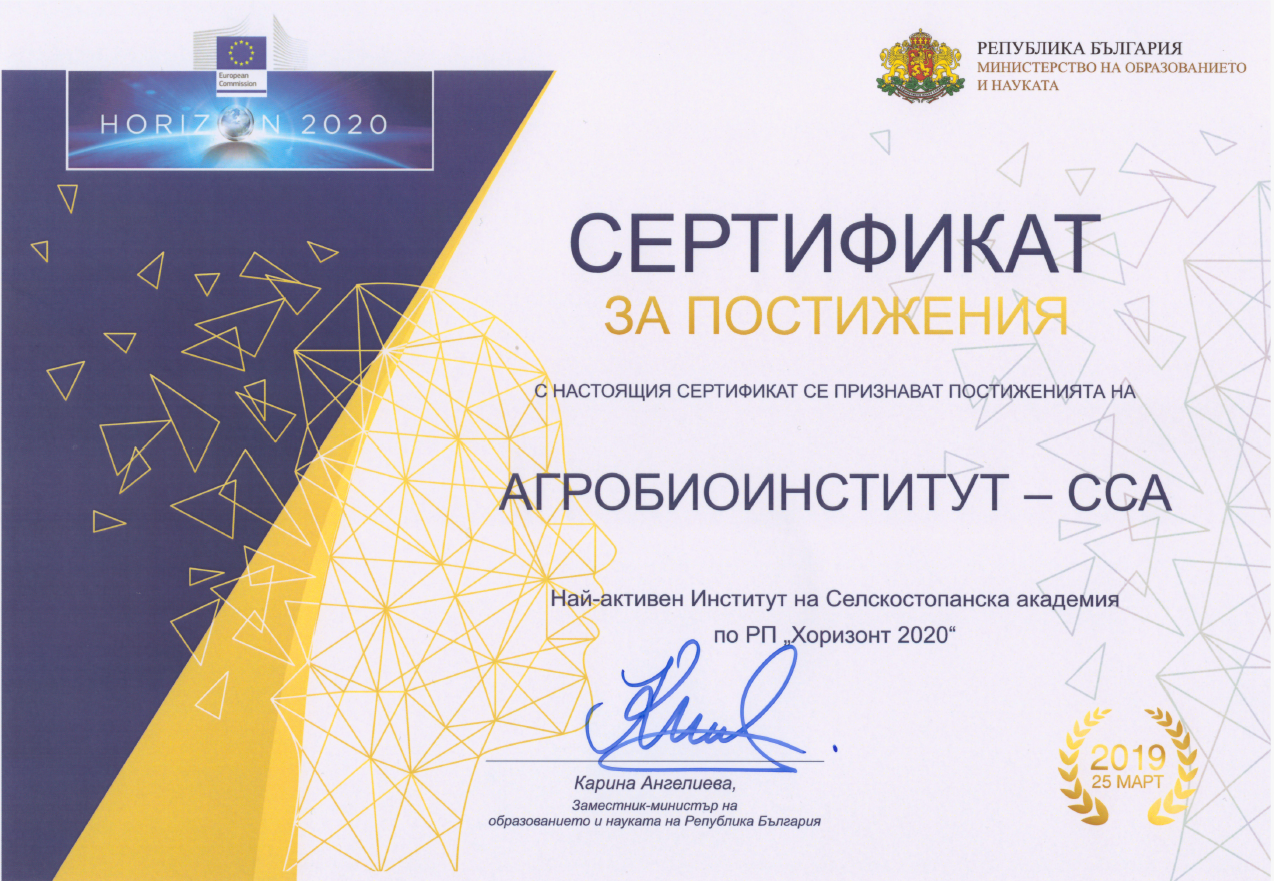
On March 25 2019, the Bulgarian Ministry of Education and Sciences held an award ceremony to celebrate the Bulgarian organisations most successful in Horizon 2020. STARBIOS2 partner Agrobioinstitute (ABI) was awarded for being one of them.

The STARBIOS2 consortium is proud to see ABI among the award winners, crossing our fingers for even more success coming their way.

ABI's certificate for winning the award.

Keep up to date with STARBIOS2 news! Subscribe to our newsletter.

UNESCO workshop

STARBIOS2 & UNESCO: Towards a sustainable science

Editorial TeamRRI

Science and society are connected. Without this connection, European research is at risk. In Paris, on March 19, the STARBIOS2 project hosts a workshop supported by UNESCO on the topic of sustainable science: Towards a sustainable science. A Model of Responsible Research and Innovation in the Biosciences”.

STARBIOS2 is looking to implement structural change geared towards responsible research and innovation in bioscience research institutions. UNESCO have been working for some time on the concept of “sustainability science” and guidelines for the higher education system.

In joining forces, the March 19 workshop is an opportunity to discuss converging and highly relevant approaches and perspectives to strengthen the relationship between science, innovation and society. From general discussion about responsibility and sustainability in science and research to detailed discussions on the model for responsible research and innovation in the biosciences that STARBIOS2 is developing.

We will be tweeting from the event. Follow along under #SustainableScienceRRI on Twitter.

Sign up for STARBIOS2 news

STARBIOS2 & UNESCO workshop

New publication from STARBIOS2

A model for promoting Responsible Research and Innovation (RRI)

Editorial TeamRRI

A recent publication in JMIR research protocols describes the progress of the responsible research and innovation (RRI) project STARBIOS2. The project aims to develop models for how to implement structural changes in bioscience research institutions, to allow them to move towards responsible biosciences. Six institutions participate by developing and implementing their own RRI action plans and the project is expected to have significant impact on their organisational processes and structures.

The six STARBIOS2 partners implementing RRI action plans are working to change organisational structures for public engagement, gender, education, open access and ethics. During the course of the project, they will share what they have learned. Based on their experiences, the project will develop a model for bottom-up approaches to implementing RRI in different kinds of bioscience research institutions.

By interpreting RRI and analysing the value of RRI to the field of bioscience, and in parallel assessing and promoting structural changes in partner institutions, STARBIOS2 will be able to provide tools for other bioscience institutions to do the same. The joint experiences from developing and implementing action plans will be put to the test by an additional three partners in Brazil, South Africa, and the US bringing valuable insights with their international perspective. The technical assistance team, monitoring and assessment team, and communications and dissemination team support the action plan implementation.

“STARBIOS2 results could help researchers make discoveries and innovations in better alignment with societal values and needs” says one of the authors, Professor Vittorio Colizzi from the Department of Biology at the Univeristy of Rome Tor Vergata.

Looking forward, the authors expect STARBIOS2 will have great impact on structures and organisational processes among the partners who implement RRI action plans, positively affecting the uptake of RRI in those institutions. As other organisations implement the guidelines and model, the impact of the knowledge developed by STARIOS2 will increase with time.

The STARBIOS2 approach to RRI takes into account some of the more diverse and complex challenges of bioscience, for example public awareness of epidemics and vaccines, social responsibility for global nutrition, and open access to big data. The project encourages collaboration across disciplinary boundaries and regions, and between scientists and non-scientist. Something the authors believe is necessary to regain the public trust in science, and to introduce novel bioscience findings.

By Anna Holm

Colizzi V, Mezzana D, Ovseiko P, et al., Structural Transformation to Attain Responsible BIOSciences (STARBIOS2): Protocol for a Horizon 2020 Funded European Multicenter Project to Promote Responsible Research and Innovation, JMIR Research Protocols (preprint), accepted 25 Sept 2018


Subscribe to our newsletter